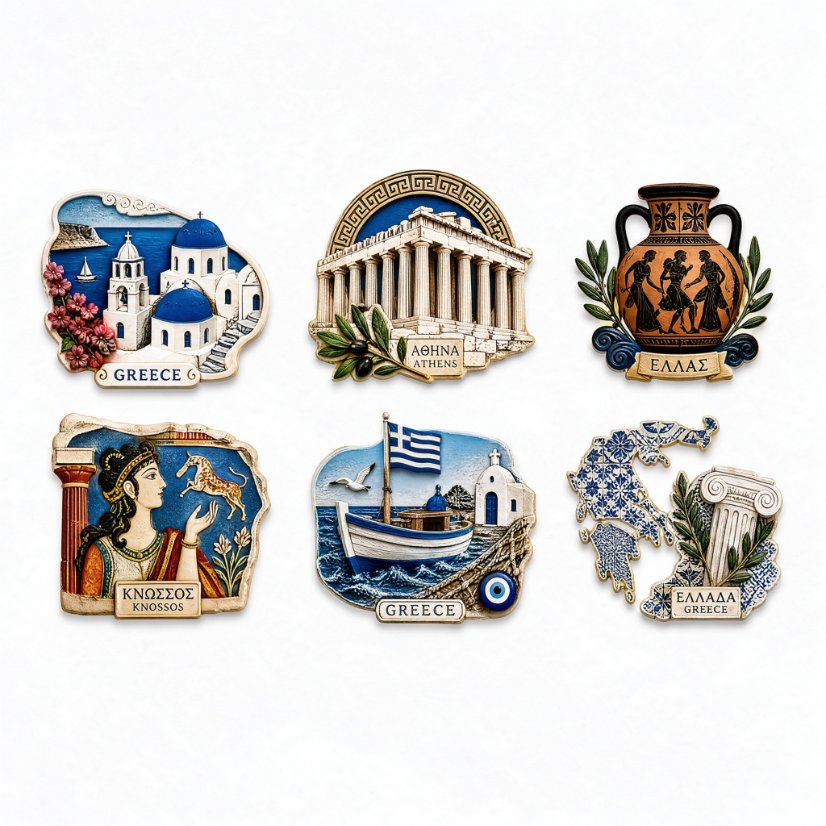
Approve a fridge magnet face with a versioned artwork proof that separates exact wording, relief areas, colour regions and the outer design boundary. Mark each change against the same design reference and record what the decision covers. Luen’s catalogue presents several Greece-themed souvenir faces, while its product description offers relief and other finish options. The illustration does not confirm a physical relief depth, a material grade or a standard six-piece assortment. Request a model-specific proof instead of approving only a general resemblance.
Choose one face before reviewing the whole collection
The fridge magnet product page is the starting reference for the enquiry. Give the selected face its own buyer reference and retain the original catalogue image. The pictured composition contains different landmark, map and decorative motifs; their presence together should not be interpreted as the normal contents of a retail set.
If the buyer wants several faces, create a separate proof record for each. Keep any collection-level relationship in a different field. This prevents a correction to one design from becoming an unexplained approval of the others and avoids turning an attractive catalogue arrangement into a confirmed orderable assortment.
• Exact face reference and design revision.
• Wording and visible artwork regions to review.
• Decision, open questions and supplier response for that face.
Record the exact lettering as editable proof content
Copy the requested wording into a text field supplied by the buyer, and ask the supplier to return the same wording with its position shown on the artwork. Keep place names, scripts, punctuation and line breaks visible. A small catalogue picture should not become the only source for a character that the buyer cannot read reliably.
Where more than one script or language appears, request an appropriate responsible review of the final text. Do not silently translate or replace a character to make the layout look balanced. Store a text correction with the affected face reference so that a later decorative change cannot accidentally restore an earlier spelling.
Proof region
Question to resolve
Decision does not establish
Lettering
Exact text, script, line break and location
A verified translation from a tiny catalogue image
Relief area
Which regions are proposed as raised or recessed?
Physical depth or a completed mould
Colour area
Which colour belongs to which marked region?
A tested colour or surface-performance result
Outer boundary
Which outline belongs to the chosen face?
A measured sample size from the picture
Separate relief intention from colour shading
The product description refers to relief craftsmanship and several decorative processes. Ask the supplier to identify which treatment is proposed for the exact design. A shaded catalogue image can suggest depth without providing a physical section, a measured relief height or a clear allocation of every surface treatment.
Use a marked region map to distinguish the areas that need clarification. Keep a raised-region proposal separate from a printed or coloured area and request the supplier’s explanation where the artwork is ambiguous. These are design questions, not a claim that a specific production process has already been confirmed or that a finished sample has been evaluated.
Mark colour decisions by region rather than by impression
Ask for a labelled colour reference linked to the selected design revision. Distinguish the lettering, background, border and decorative details where that helps the supplier answer. A response such as match the blue picture leaves unclear which blue region and viewing reference the buyer intended.
Record the scope of an appearance decision and the reference used to make it. If the parties need a controlled colour comparison, they should agree on its method and criteria separately. Do not turn a screen observation into a measured tolerance or infer scratch resistance, corrosion resistance or another finish outcome from an attractive surface appearance.
Keep the outer outline and size request traceable
The supplier page says sizes can be customised according to the client’s specifications or drawings. Attach the buyer’s requested size definition to the chosen face rather than measuring the catalogue composition. Name the intended directions and endpoints, especially where the design has an irregular map, landmark or decorative outline.
Keep the requested size separate from the supplier’s confirmed response. A proof that establishes the arrangement of wording and motifs does not automatically establish the final dimensional specification. If the artwork is resized, ask which text, border and relief details need renewed review for that particular version.
Review the physical sample as a separate stage
A digital face proof and an actual sample answer different questions. Keep the digital approval reference with the sample request, then record which sample and version are received. Do not describe the catalogue illustration as a photograph of an inspected sample or treat a digital region map as evidence of the actual material or magnetic backing.
The supplier description mentions material, backing and packaging options, but their availability and applicability need confirmation for the offered item. Those fields belong in separate responses. Face-artwork acceptance alone does not approve magnetic strength, a material substitution, the back construction or the contents of a supplied package.
Close changes with a clear approval boundary
Return one consolidated correction list tied to the face reference and proof revision. Identify the region, requested change and expected supplier response, then retain the earlier version. This makes it possible to see whether a new proof addresses a specific correction without assuming that every unmentioned feature was independently checked.
Before an order is released, the responsible buyer should supply or confirm the artwork it is entitled to request; a catalogue example is not evidence of a licensing relationship. Send the approved revision and remaining questions through Luen contact, and retain the supplier blog as a separate reference point. No price, minimum order, certification or delivery commitment is established by this guide.
Frequently asked questions
Does the six-design catalogue picture define a retail set?
No. It presents several faces in one composition. Ask the supplier to confirm the offered item or assortment and its commercial contents separately.
Can shadows in the artwork establish relief depth?
No. Request a region map and the supplier’s model-specific explanation. A digital appearance does not provide a physical depth measurement.
Does approving the face approve the backing or material?
No. Keep material, back construction, magnetic properties and packing information in their own supplier responses.
What should happen after a spelling or layout correction?
Retain the earlier proof and request a new identified revision showing the change. Record which face and review scope the decision covers.
Product and contact references
https://luensouvenirs.com/product/fridge-magnet/
https://luensouvenirs.com/contact/
https://luensouvenirs.com/blog/